From Fire to Artificial Intelligence: How Humanity Survives Its Own Creations
by Tiragalo Gwebu
Fire and the Beginning of Human Power
Every era of history has been shaped by a technology that fundamentally altered what it meant to be human. Long before computers, rockets, or artificial intelligence, there was fire. Fire transformed fragile communities into societies capable of surviving harsh climates, preparing food, creating tools, and eventually building civilizations. Yet the same discovery that preserved life also introduced new forms of destruction through warfare, accidents, and the control of resources. This pattern has repeated itself throughout history. Human beings rarely create technologies that are purely beneficial or purely harmful. Instead, every great invention expands both opportunity and risk. The question has never been whether humanity can innovate; history has repeatedly answered that with a resounding yes. The greater challenge has always been whether societies can govern the consequences of their own ingenuity before those consequences begin governing them.
Civilization as a Series of Adaptive Crises
The rise of agriculture, metallurgy, writing, the printing press, industrial machinery, nuclear technology, and the internet all produced moments of profound uncertainty. Each innovation disrupted existing institutions, redistributed power, and forced societies to rethink law, economics, and culture. Entire civilizations have risen and fallen because they either adapted successfully or resisted necessary change. The collapse of the Bronze Age, the social upheavals following the Black Death, and the transformations of the Industrial Revolution all reveal the same lesson: civilization survives not because crises are avoided, but because institutions evolve in response to them. Governance has therefore always been humanity's hidden survival mechanism. The strength of a civilization lies less in its technological achievements than in its ability to create systems capable of managing those achievements responsibly. History demonstrates that resilience is ultimately an institutional virtue rather than merely a technological one.
Artificial Intelligence and the Governance of Intelligence
Artificial intelligence represents a different category of technological transformation because it amplifies cognition rather than physical labor. Previous revolutions mechanized muscles, transportation, communication, or manufacturing. AI increasingly participates in analysis, prediction, creativity, and decision-making itself. This raises questions that extend beyond economics into ethics, law, and political philosophy. If algorithms assist in governing societies, diagnosing illnesses, educating children, or influencing democratic processes, then governance must evolve alongside the technology. The central political challenge is no longer simply regulating machines but preserving meaningful human agency within increasingly automated systems. Effective institutions must therefore balance innovation with accountability, ensuring that technological capability never outruns ethical responsibility. The future will belong not to the societies that possess the most advanced AI, but to those that cultivate the wisdom to govern it.
Human Flourishing in the Age of Creation
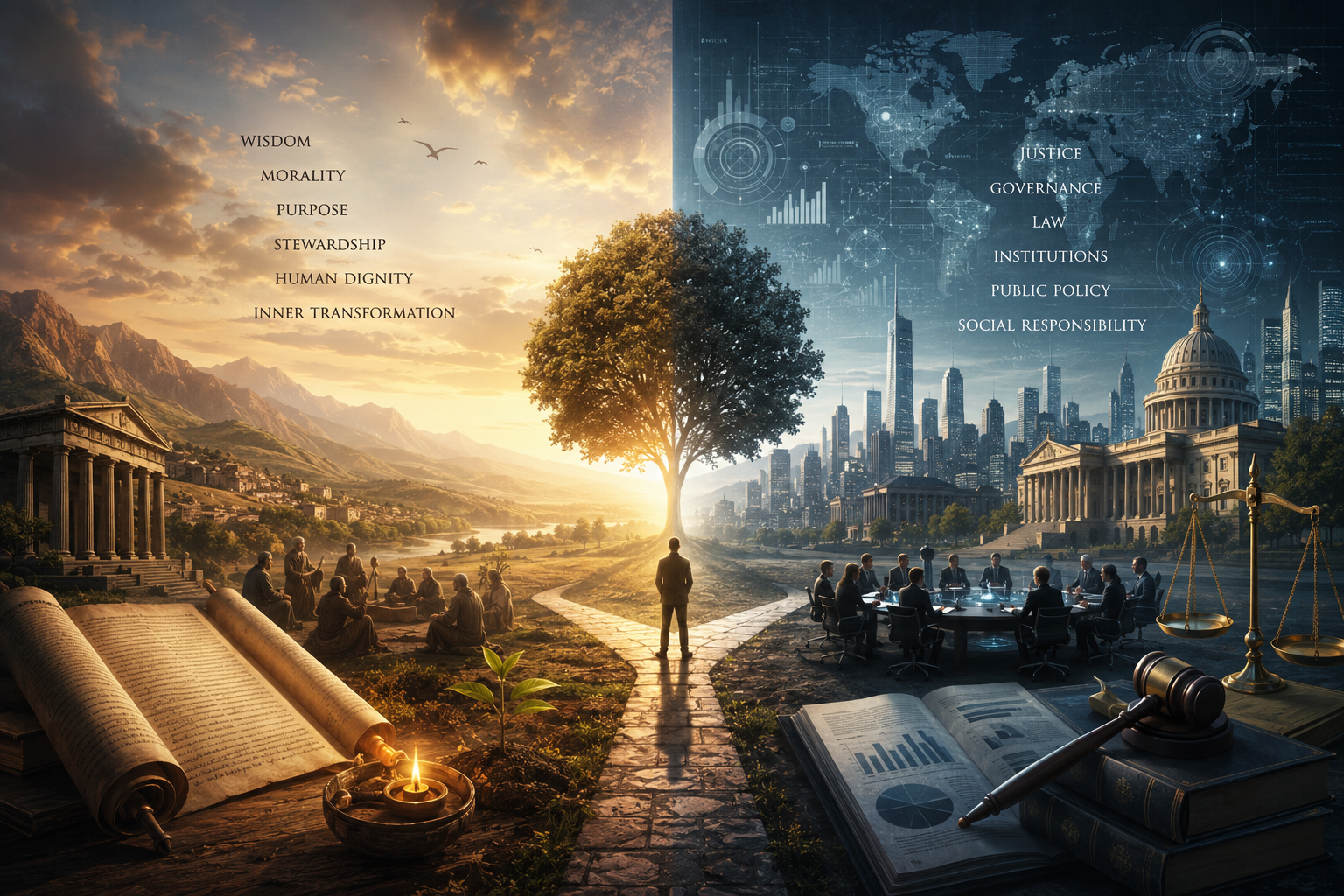
History suggests that humanity has always survived its greatest inventions by rediscovering the principles that make civilization possible. Technological progress alone has never guaranteed human flourishing. Justice, accountability, education, virtue, and responsible leadership have consistently determined whether innovation became a force for liberation or oppression. Artificial intelligence presents another chapter in this long historical story rather than its conclusion. The question before governments, philosophers, and policy makers is not whether progress should continue, but what kind of civilization that progress is intended to build. If technology continues advancing while moral and institutional development stagnates, the risks become increasingly difficult to contain. Humanity survives its own creations not by slowing innovation, but by ensuring that wisdom, governance, and ethical responsibility advance at the same pace as invention.